When we pick up the Bible to read, we don’t do so in a vacuum. We read it in the light of everything we have heard about it and from the context of the society we grew up in. It leaves us with the very real question of how to interpret the Bible. Now, I was told once, “I don’t interpret the Bible, I just read what is there.” When I asked the gentleman which version of the Bible he read, he answered, “The King James Version, because if it was good enough for Jesus, it’s good enough for me.” Up until that moment, I had heard jokes about such people but doubted if any still existed in the modern age. Now, even as I tried to explain to him that Jesus had no books because the printing press would not be invented for another thousand years, and that the English Language did not even exist when Jesus was born, and that he probably spoke Hebrew and Aramaic, he just looked at me blankly. Then he got up and left.
If we could pick up the Bible, read it, and clearly discern the truth for ourselves, there would not be hundreds of denominations in the world today, and there would be no need for a church. But such an existence would be completely foreign to Christianity. In fact, it would not be Christianity. Christianity is lived, learned, and understood in community, as it always has been. Interpretation is part of what we do when we seek to understand the words we read in the Bible, and it is the church and those who came before us who help us understand their meaning. But if we don’t ask that question, “How do we read the Bible?” We will be approaching dangerously close to making assumptions as incorrect as the man who claimed to read the King James version because it was what Jesus read, or we will be cursed with reading it solely through the cultural interpretation of our society. Unfortunately, our society is in flux, and we are coming to the end of the age of modernity, which drew heavily on the ideas we call the “enlightenment.” Now, there is no doubt that science has taken our society farther than we ever could have gone without it. Yet today, we seem to have forgotten that science began with the most educated among us…monks and priests. The very reason that they felt they could apply reason to make sense of the world was that they believed the world made sense. Why did they think that? Because they believed that the world was not random, the Living God had created, and the Natural Laws, which were also Divine Laws, made sense within the mind of God and therefore would make sense to our minds, created by God, so that we could seek him through the mysteries of the Creation. Science has taken the methods they used and completely forgotten the reason they thought those methods could be applied to the world in the first place.
Our society, formed by the Enlightenment, is ever eager to reject superstition and anything that looks like tradition, without discerning whether it was good or not. That means that when we read the Bible from a culture that, today, rejects the entire spiritual world, we have rejected the very core of Biblical teaching before we even start. The predominant concept of our world leaves us with the rather odd dichotomy of belief that you can have invisible entities or things that pass-through walls in Star Trek (either because the only light they reflect is in wavelengths we cannot see, or because they are from a different dimension than ours), but if we were to posit the same creature abilities from a spiritual standpoint, those creatures are automatically assumed to be hogwash. Not scientifically disproven, rejected out of hand. Why? Because they cannot be disproved. This is what, if we were honest, we would call hypocritical.
The existence of angels and demons was assumed in virtually every human society and culture worldwide. But rather than exploring what angels and demons are and how they relate to and interact with our modern world, a culture dominated by “Scientism”* and radical materialism** rejects everything spiritual and with it the entire unseen world completely out of hand. Not only that, but despite the witness of millions upon millions of people who have claimed to see or interact with the spiritual, adherents to Scientism and radical materialism reject these experiences completely out of hand without even pausing to consider why disparate societies might have developed similar ideas. Not very scientific of them, is it? Is that even rational?
It has not always been this way. Belief is a choice. The existence of God has been a reality to the greatest leaders of our society, from St. Paul to St. Joan of Arc, and from Washington to Eisenhower.
However, this radically materialist stream of “modernity” has built a “modern” Christianity that, seeking to be relevant with our “enlightened” society, rejects the very core of Biblical tradition and the testimonies and realities it attests to as “unscientific” or “superstitious.” It has, therefore, lost its very soul to the ebb and flow of “modern” culture’s whims and prejudices. Yet is our culture that modern? The rejection of everything that cannot be proven in a laboratory (which would include the concepts of honor, love, loyalty, and brotherhood) is an approach that dates back almost 200 years to Darwin and has spawned the modern world, with all its failings. Now, as we approach the post-modern reality, culture is shifting and asking what our grandparents missed. Meanwhile, the science of scientism has found underlying patterns that run throughout creation, from the macroscopic to the microscopic, and such patterns cannot be random; they hint at a designer. And, of Nature’s God asks the question: “Is it possible that some of what was rejected were actually foundational to our society and our faith?” Are the missing pieces of our society and our personal sense of emptiness both to be found in the faith that Scientism and radical materialism reject?
So, when we ask, “How Do We Read the Bible?” we must call into question the predominant assumptions of “modern” society that we have been taught from childhood. Because if we don’t recognize our own prejudices, like the man I spoke about at the beginning, we will be unable to find our way out of error. Perhaps it’s time to find a new way. Or a new, old way. How do we interpret the Bible? If we are going to look at the question with “new” eyes, let us go back to the beginning and see how the first Christians viewed it.
The Early Church Fathers on Scripture and Tradition
The Bible was never meant to stand alone, my friends. When we turn to the earliest Christians, we find them holding Scripture in the highest honor, inspired and essential as the foundation of our faith. Yet none of the teachers or prophets who came before ever believed that scripture alone is sufficient as the sole rule of faith. Instead, they consistently presented Scripture and apostolic Tradition as two streams flowing from the same source, guarded by the living Church. St. Irenaeus of Lyons (c. 130–202) battled heretics who twisted Scripture. In “Against Heresies,” he showed that the apostles delivered the Gospel both in writing and by living voice. This “rule of faith” preserved through apostolic succession serves as the indispensable lens for rightly reading the Bible. Without it, Scripture becomes a “nose of wax” that anyone can bend to fit their own ideas .
St. Basil the Great (c. 330–379) spoke with striking clarity in On the Holy Spirit:
“Of the dogmas and messages preserved in the Church, some we possess from written teaching and others we receive from the tradition of the apostles… Both have one and the same authority… They did not hand down everything by letter… Let us regard the tradition of the Church also as worthy of belief. Is it a tradition? Seek no further.”
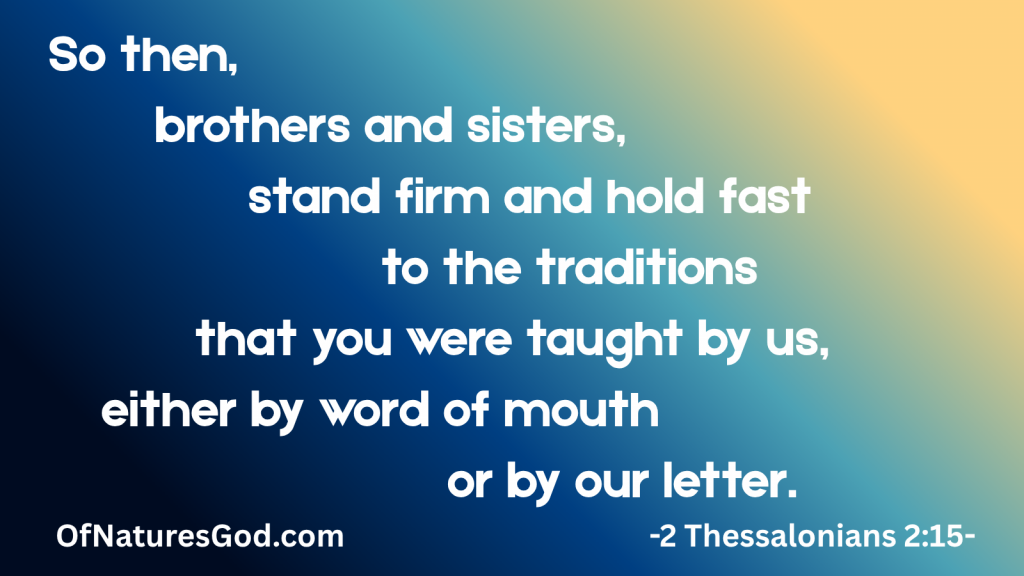
He listed practices such as the sign of the cross, facing east in prayer, and the words used in baptism and the Eucharist — none spelled out in Scripture, yet binding because they come from apostolic Tradition. St. John Chrysostom echoed St. Paul: “Stand fast and hold the traditions which you were taught, whether by word or by our letter” (2 Thess 2:15). He added, “Many things were delivered unwritten… Therefore, let us think the tradition of the Church also worthy of credit. It is a tradition; seek no farther.” St. Augustine (354–430), who loved Scripture deeply held the canonical books as error-free, he also received universal customs like infant baptism as apostolic Tradition, even when not explicitly detailed in the text, because they had been passed down in the community of the faithful. St. Vincent of Lérins (d. c. 445) gave the classic rule: what has been believed everywhere, always, by all. He asked why we need the Church’s interpretation if Scripture is complete. His answer? Because Scripture is so rich and deep that it admits many interpretations. Therefore, we must hold both the Divine Law and the Tradition of the Catholic Church.
The Coherent Witness from the early church fathers and apostolic tradition share a consistent truth:
Scripture contains the truth that forms the ground of our faith and holds the key to salvation;
Scripture was never meant to stand alone or interpret itself but to stand within the community of the Church (not formally sufficient);
Apostolic Tradition and the Church’s living authority provide the God-given context in which Scripture is rightly understood and protected from fragmentation – and it is the Churches interpretation handed down through the ages securely thru apostolic succession that has from the very beginning defined the parameters of our belief.
This is not “adding to” Scripture. It is receiving it exactly as the apostles delivered it — inside the community of God, where the same Holy Spirit who inspired the writers continues from the first apostles, through the church councils that created the Bible and our historic creeds to guide us and keep us from error, that same Bible that tradition handed down to us today, and whose interpretation is guarded by the Church and used to test any ideas that other Christians may try to teach us to ensure that they are truly part of the Apostolic tradition.
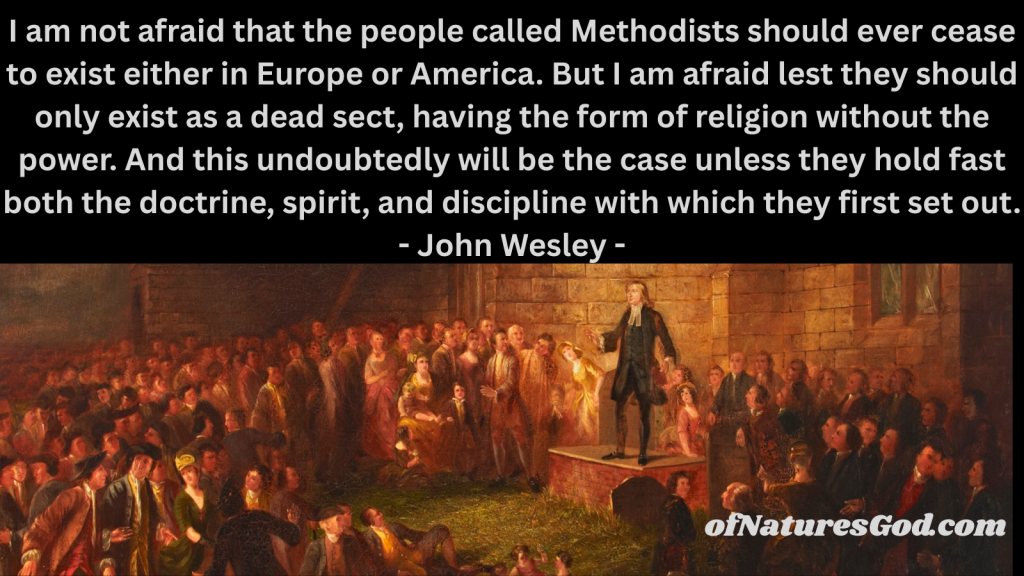
Much, much later, there would come down a new idea to challenge the Apostolic tradition as we have discussed here, and that new concept was the concept of Sola Scriptura – this was the idea that Scripture was the only infallible rule, detached from Tradition and the Magisterium of the holy and apostolic Catholic Church. They would claim that this was the only true ground of the Faith of Christ. As we have seen, this new teaching was indeed foreign to the Apostolic Traditions of the early church. This new teaching would exalt the Bible as an authority greater than the earliest church traditions – the practices of the apostles preserved in the communities of faith – and indeed, above the witness of the Holy Spirit itself. Indeed, I would offer that such a faith is not so much a faith in the Living God as a false teaching that has elevated the book handed down to us by our traditions above God Most High, and is at worst replacing a relationship with the Church and the Living God with a book of the printed word and that it is, at its worst, a form of idolatry and, at its best, misguided. We have briefly looked at how the earliest Church and the apostles viewed the faith. However, you will find many sincere and heartfelt Christians who cling to this new idea of Sola Scriptura and would insist the Bible is the only true authority of the Church, some even going so far as to discard the earliest Creeds the church formed to combat heretical teaching among their communities. We will go more into this new idea of Sola Scriptura (new as in dating back nearly to the Reformation of the 16th Century, rather than to Jesus and the Apostles) in our next post. Then we will look at why many Protestant churches claim to be guided by sola scriptura and how that claim may ring hollow. We will look at the claim, examine it closely, and contrast it with the apostolic faith, so we can be enlightened about our own faith and be able to give an answer to others for our faith and the hope that is in us.
The apostolic faith, which includes, at a minimum, the earliest creed of the church, the Apostles Creed, has been a witness to our faith from the beginning of Christianity. If this ancient witness and our discussion here stir more questions in you, or simply a longing to know more, then stay with us here. If you feel a longing in you for a more unified, coherent Christian faith — one that holds Scripture, reason, history, and lived experience together without fracture — you are in good company. There is an authority upon which we can base our faith, so we are not led astray, and many have walked this road toward greater discovery. I began this journey at ofNaturesGod.com as a Protestant minister; however, my search for truth has finally brought me, this Easter, into full communion with the Holy Roman Catholic Faith, and I will do my best to show you why I have found that to be the truest path into communion with the Living God, after more than 60 years of searching. More and more people today are discovering that the Catholic understanding is not a burden but a liberation into the fullness of what God has revealed, and that many of the assumptions and beliefs they were taught about the church were in error.
Until we pick up the journey again, test everything, hold fast to what is good, and may the Spirit who guided the apostles lead us all deeper into truth.
Your brother in the journey,
Rivan Elan (Pastor Daniel)
Of Nature’s God